
Voice Recognition Software in 2026: From Dragon to AI-Native Apps
How voice recognition software evolved from Dragon NaturallySpeaking's $300 trained vocabulary to open-source AI models that run locally on your Mac.
Voice recognition software has changed more in the last four years than in the previous twenty. The product that defined dictation for a generation — Dragon NaturallySpeaking — no longer runs on Mac. It was discontinued in 2018, its parent company was acquired by Microsoft for $19.7 billion in 2022, and the software's core technology was outpaced by open-source models that anyone can run for free.
Meanwhile, apps built on those open-source models now achieve accuracy that Dragon's engineers would not have believed possible in 2010, run entirely on your laptop without an internet connection, and cost a fraction of what Dragon once charged.
This is the full history of how we got here — and what to use today.
Here's a timeline of how voice recognition software evolved from Dragon to modern AI-native apps:
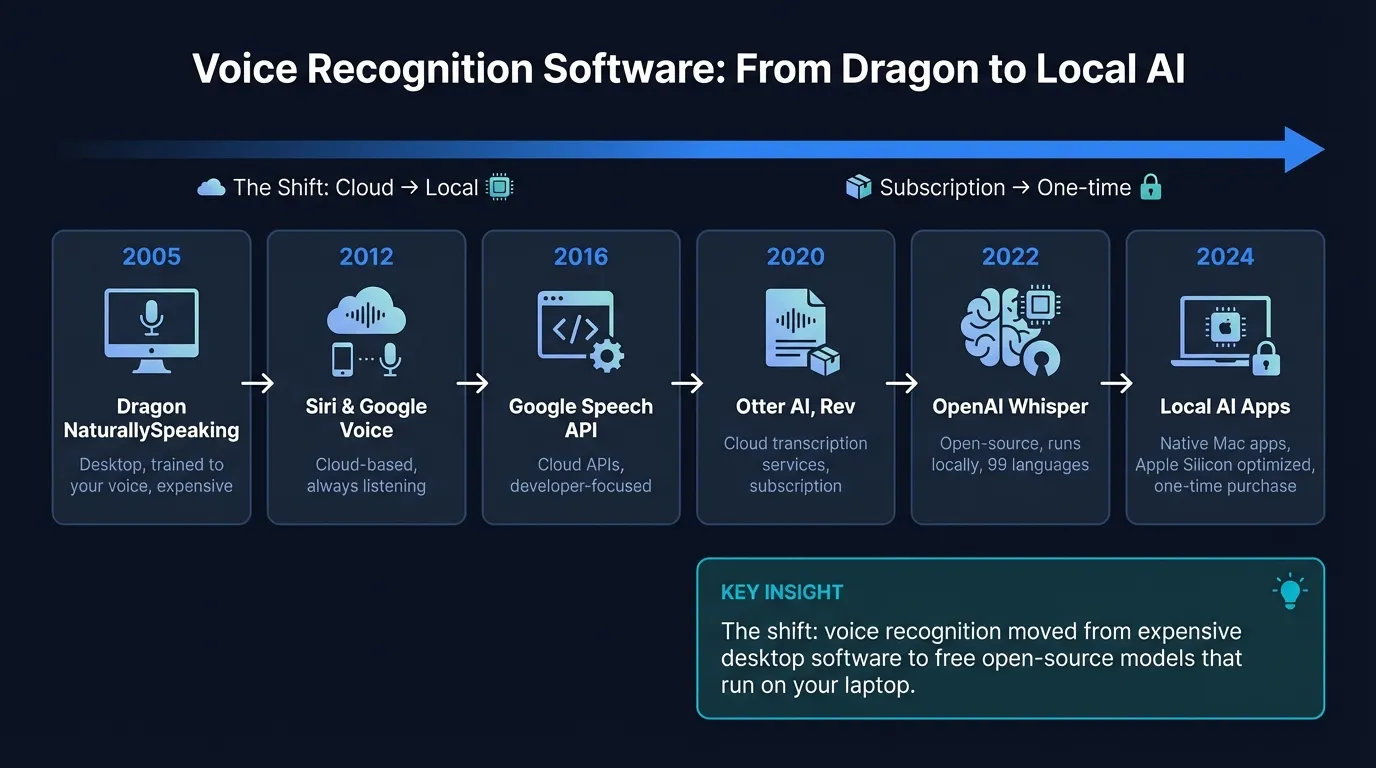
How voice recognition software has changed#
| Era | Representative products | Processing | Price model | Accuracy ceiling |
|---|---|---|---|---|
| Desktop AI (1997-2010) | Dragon NaturallySpeaking | Local (trained) | $100-$300 one-time | ~95% after training |
| Cloud ASR (2011-2018) | Google Speech API, Siri | Cloud servers | Per-minute API fees | ~92-95% zero-shot |
| Cloud transcription (2018-2022) | Otter.ai, Rev, AssemblyAI | Cloud servers | Subscription | ~93-96% |
| Open-source local AI (2022-) | Whisper, Parakeet | Local (on-device) | Free or one-time | 96-98.4% (LibriSpeech) |
The Dragon era: local processing, trained vocabularies (1997-2018)#
Dragon Systems released NaturallySpeaking 1.0 in 1997 — the first product to offer continuous dictation on a consumer PC. Before Dragon, voice recognition required users to pause between each word. NaturallySpeaking was the first to let you speak naturally and get accurate transcription.
The technology was genuinely impressive for its time, but it had hard limits. You had to train the software to your voice — a multi-hour process of reading passages aloud while the software built a model of your specific pronunciation patterns. Accuracy was high for your own voice but dropped significantly for anyone else. The software shipped with massive vocabulary databases stored locally, which is why Dragon installations required significant disk space.
Dragon dominated the professional dictation market for most of two decades. In the medical and legal fields, where accurate transcription of specialized terminology was critical, Dragon's custom vocabulary training had no competition.
Then the market shifted. Nuance Communications acquired Dragon's assets in 2001 for $39.5 million. Nuance held roughly 70% of the global speech recognition market at its peak, but that dominance eroded as cloud-based systems from Apple, Google, and Amazon began capturing consumer users. By 2018, Nuance's market share had dropped to 31.6% according to industry data. Dragon for Mac was discontinued that same year.
Microsoft acquired Nuance for $19.7 billion in April 2021, completing the deal in March 2022. Dragon NaturallySpeaking continues as Dragon Professional for Windows users in specialized markets. For Mac users, the product is gone.
The cloud shift: Siri, Google, and the era of server-side speech (2011-2018)#
When Apple launched Siri in 2011 and Google released Google Now in 2012, they introduced a different model: audio goes to a server, processing happens in the cloud, result comes back. The trained-vocabulary approach was replaced by massive neural networks running on data center hardware.
The cloud approach had real advantages. You didn't need to train the software to your voice. Language models could be updated centrally without users downloading anything. And because the models ran on powerful server hardware with no memory or compute constraints, accuracy on zero-shot (untrained) speech improved rapidly.
The trade-offs were significant: internet connectivity required for every transcription, audio sent to external servers, per-minute API pricing for developers, and subscription pricing for end users. These limitations seemed acceptable when on-device hardware wasn't powerful enough to run competitive models locally.
For professional dictation, cloud tools like Otter.ai (launched 2016) and Rev's transcription service filled the gap left by Dragon's decline on Mac. These worked well for meeting transcription but weren't designed for real-time, system-wide dictation into any app.
OpenAI Whisper: the turning point (September 2022)#
OpenAI released Whisper in September 2022. The announcement was quiet — a paper and a GitHub repository — but the impact on voice recognition software was substantial.
Whisper is an encoder-decoder transformer trained on 680,000 hours of multilingual audio scraped from the internet. The scale of training data was unlike anything previously available for an open-source model. The result was zero-shot transcription that required no voice training, supported 99 languages, and ran entirely on local hardware.
The accuracy numbers changed the competitive picture. Whisper Large V3, released in late 2023, achieves 1.6% word error rate on LibriSpeech clean audio and 3.1% WER on LibriSpeech other — the standard benchmarks for English speech recognition (OpenAI, 2023). That's meaningfully better than what cloud services were achieving on comparable audio.
Crucially, Whisper is MIT-licensed. Anyone can use it, modify it, or build products on it without licensing fees.
Within months of Whisper's release, developers started building Mac apps on top of it. MacWhisper appeared for file-based transcription. SuperWhisper packaged real-time dictation with a global hotkey. The pattern was consistent: take Whisper, add a native Mac interface, and ship.
The Dictation App Built for Mac
No subscriptions. No cloud. Just fast, accurate voice dictation that works in every app.
What changed when local AI models became competitive#
The shift from cloud-dominant to local-competitive voice recognition happened faster than most people expected, for three reasons.
Apple Silicon raised the floor for on-device AI. When Apple started shipping M1 chips in 2020, the Neural Engine performance per watt improved substantially over previous Intel hardware. Whisper Large V3 on an M2 MacBook Pro processes audio at roughly 2x real-time — fast enough for practical use. On M3 and M4 chips, it's faster still. The hardware constraint that made cloud processing necessary on laptops disappeared.
NVIDIA Parakeet changed the speed equation. In 2024, NVIDIA released Parakeet TDT under Apache 2.0 license. Parakeet is optimized specifically for English and processes audio significantly faster than Whisper — under 50ms latency on Apple Silicon in streaming mode. Apps that use Parakeet as their default engine (Hearsy is one) can return text while you're still speaking, a qualitative difference from Whisper's chunk-based processing. The trade-off is language support: Parakeet handles English only, while Whisper covers 99 languages.
The accuracy gap between local and cloud closed. Cloud services use OpenAI's speech API or similar infrastructure, which is Whisper-equivalent or Whisper-based at this point. Running Whisper locally gets you the same model that cloud services are running, without the network hop. The argument for cloud processing was never privacy or cost — it was accuracy. That argument is gone.
Cloud vs local voice recognition in 2026#
The question isn't accuracy anymore. It's these three things:
Privacy. Cloud apps send audio to external servers. For personal emails, this may not concern you. For medical notes, legal briefs, financial discussions, or anything confidential, audio leaving your device is a real consideration. Apps like Hearsy, SuperWhisper, and VoiceInk run entirely on-device. Nothing is transmitted. You can verify this with a network monitor like Little Snitch — a local dictation app makes no outbound connections while transcribing.
Offline capability. Local apps work on planes, in areas without connectivity, or in enterprise environments with restricted outbound network access. Cloud apps require internet for every transcription — no connection, no dictation.
Cost model. Cloud transcription services charge monthly subscriptions because server infrastructure requires ongoing cost. Local apps can charge a one-time fee because there's no per-transcription server cost. Wispr Flow and Otter use subscription pricing. Hearsy, VoiceInk, and MacWhisper use one-time pricing. For users who dictate daily, the subscription cost compounds significantly over time.
Current voice recognition software for Mac#
| App | Engine | Processing | Offline | Price model |
|---|---|---|---|---|
| Hearsy | Parakeet + Whisper | Local | Yes | One-time |
| SuperWhisper | Whisper | Local | Yes | One-time |
| VoiceInk | Whisper | Local | Yes | One-time |
| MacWhisper | Whisper | Local | Yes | One-time |
| Wispr Flow | Cloud (OpenAI) | Cloud | No | Subscription |
| macOS Built-in | Apple ASR | Local (M1+) | Yes | Free |
| Otter.ai | Cloud | Cloud | No | Subscription |
The four local apps all use Whisper at their core. Where they differ is in additional engines (Hearsy also uses Parakeet for English speed), AI post-processing (some apps clean up transcripts, remove filler words, reformat as email or bullet points), and system scope (MacWhisper is file-based; the others work system-wide across all apps).
For former Dragon users on Mac, the migration path is one of these local apps. Hearsy, SuperWhisper, and VoiceInk all operate system-wide with a global hotkey — press a shortcut, speak, text appears wherever your cursor is. That's the same core behavior Dragon provided, with better accuracy and no training required.
What to use today#
You need system-wide real-time dictation on Mac: Hearsy, SuperWhisper, or VoiceInk. All three run locally, work in any app, and require no internet. Hearsy's Parakeet engine gives fastest response on English; SuperWhisper and VoiceInk are Whisper-only but solid.
You dictate in languages other than English: Whisper-based apps (SuperWhisper, VoiceInk, Hearsy with Whisper mode) cover 99 languages. Parakeet is English-only.
You need AI cleanup, not just raw transcription: Hearsy and Wispr Flow both post-process dictation. Hearsy does this locally using Qwen 2.5 via MLX or optionally via Claude or OpenAI APIs. Wispr Flow processes cleanup server-side.
You're transcribing audio files (meetings, recordings): MacWhisper is purpose-built for this. It's not a real-time dictation app.
You only need occasional short dictation: macOS built-in dictation is free, requires no installation, and works in any app. The 30-60 second time limit makes it impractical for extended dictation, but for quick messages it's sufficient.
You came from Dragon and need Windows compatibility: Dragon Professional still exists for Windows through Nuance/Microsoft. Nothing has replaced Dragon on Mac at the enterprise level — local AI apps are consumer and prosumer products, not enterprise workflow integrations.
The shift from Dragon's era of trained vocabulary models to today's open-source transformer-based systems changed what voice recognition software costs, where audio goes, and who has access to high-accuracy dictation. Dragon required expensive software, training sessions, and eventually a Windows machine. Whisper and Parakeet are free, require no training, and run on the Mac in your bag.
For a full comparison of Mac dictation apps, see the best dictation software for Mac guide. For privacy-specific considerations, the voice data privacy guide covers what happens to audio in cloud vs local apps. For setup steps, the voice recognition setup guide walks through installation and permissions.
Frequently asked questions#
What is voice recognition software?#
Voice recognition software converts spoken words to text in real time. It captures audio from your microphone, runs it through a speech recognition model, and outputs the transcribed text — either into whatever app you're using (system-wide dictation) or as a file (meeting transcription). Modern apps use AI models like OpenAI Whisper or NVIDIA Parakeet that run locally on your device.
Is Dragon NaturallySpeaking still the best voice recognition software?#
No. Dragon NaturallySpeaking was the dominant product for 25 years, but the Mac version was discontinued in 2018 and the parent company (Nuance) was acquired by Microsoft for $19.7 billion in 2022. Modern open-source models like Whisper Large V3 achieve 1.6% word error rate on clean speech benchmarks — better than Dragon's best accuracy figures — and run entirely on your Mac without a license fee or training requirement.
What replaced Dragon NaturallySpeaking on Mac?#
For system-wide real-time dictation, native Mac apps built on OpenAI Whisper and NVIDIA Parakeet: Hearsy, SuperWhisper, and VoiceInk. These run entirely on-device, support 99 languages (Whisper) or English with faster processing (Parakeet), and cost a one-time fee rather than hundreds of dollars per license.
What is the difference between cloud and local voice recognition software?#
Cloud voice recognition sends audio to external servers for processing. Local voice recognition runs the AI model on your Mac — audio never leaves your device. Accuracy is now comparable between the two (cloud services use the same Whisper models that local apps run). The real differences today are privacy (local = nothing transmitted), offline capability (local works without internet), and cost model (cloud = subscription, local = one-time purchase).
What is the most accurate voice recognition software for Mac in 2026?#
Whisper Large V3 achieves 1.6% word error rate on the LibriSpeech clean benchmark and 3.1% WER on more challenging audio (OpenAI, 2023). Apps that run Whisper Large locally — including Hearsy in Whisper mode, SuperWhisper, and VoiceInk — deliver this accuracy without sending audio to any server. For English-only dictation where speed matters more than maximum accuracy, NVIDIA Parakeet achieves under 50ms latency on Apple Silicon.
Ready to Try Voice Dictation?
Hearsy is free to download. No signup, no credit card. Just install and start dictating.
Download Hearsy for MacmacOS 14+ · Apple Silicon · Free tier available
Related Articles
Best Dictation Software for Mac in 2026: Honest Comparison
19 min read
Voice Dictation Software: What to Look For in 2026
12 min read
Talk to Type Software: The Best Apps for Voice Typing in 2026
9 min read
Medical Dictation Software for Mac: Dragon Alternatives for Doctors in 2026
14 min read
Best Legal Dictation Software in 2026: Honest Comparison
16 min read